

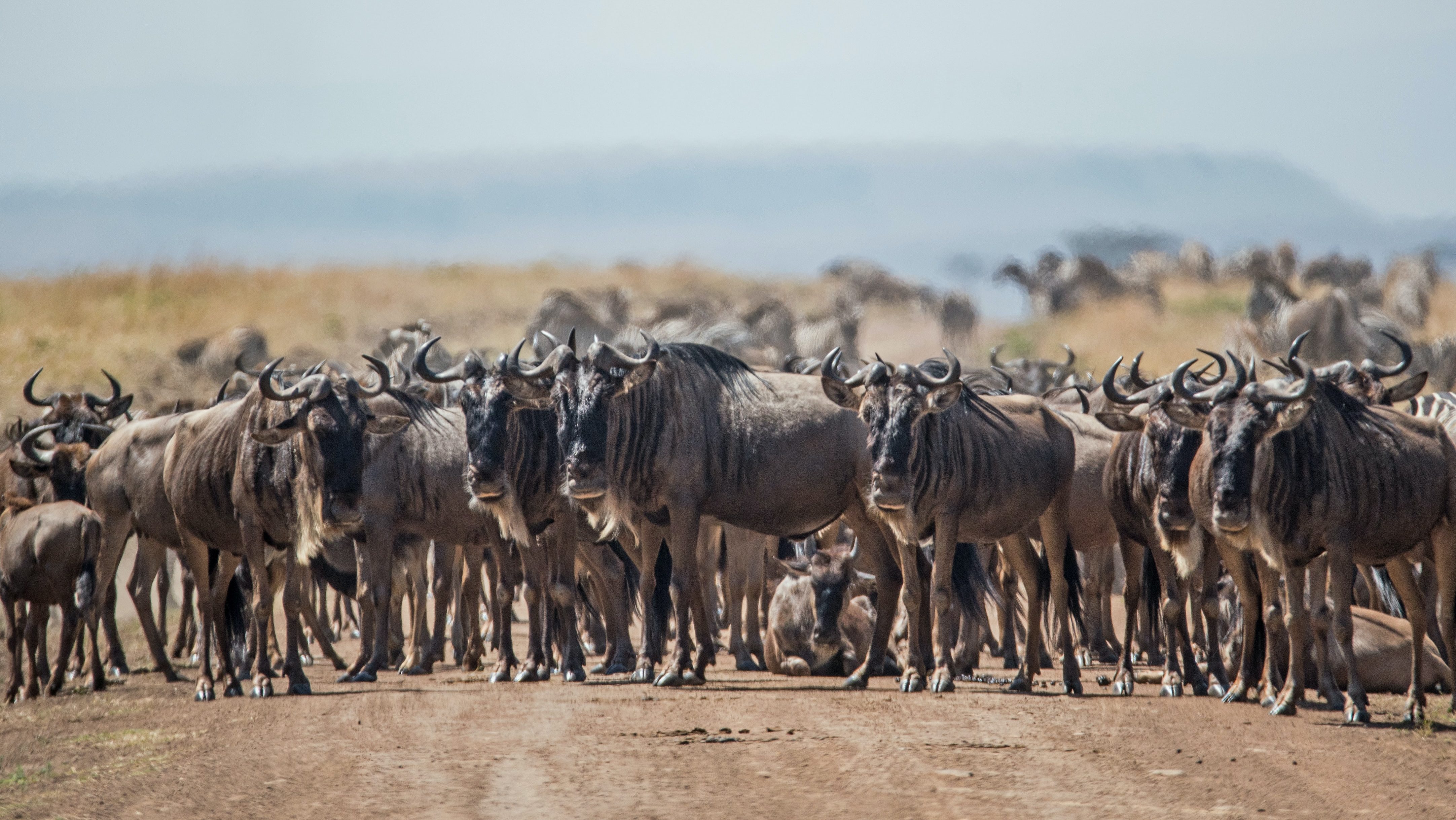
Dry rangeland systems in Africa are experiencing change, with increasing pressure on land resulting in changes in vegetation structure and function, loss of biodiversity, and reduction in wildlife biomass that all affect the provision of ecosystem services. Informing the more sustainable management and utilisation of these landscapes requires systems-level thinking and solutions that embody African perspectives, as well as state-of-the-art research tools that enable evidence and assumptions to be tested across scales. OPALS activities under this theme aim to provide better insight to decision-makers in communities, land managers and policy makers.
Example Activities
Oppenheimer Impact Scholar Alan Nare is leading the research activity Bush Encroachment at Shangani Holistic: Detection and Attribution, which investigates long-term woody vegetation change on the ranch. The project combines multi-decadal satellite imagery (1989–2024), field measurements, and fixed-point photography to detect patterns of woody expansion at Shangani Holistic Ranch and surrounding landscapes. It then attributes observed changes to potential drivers by integrating satellite-derived fire records, spatial data on cattle kraal locations, and wildlife aerial survey data. By evaluating how fire regimes and livestock and wildlife herbivory shape vegetation dynamics, the study aims to disentangle the mechanisms behind bush encroachment and generate robust evidence to support adaptive, science-based rangeland management.
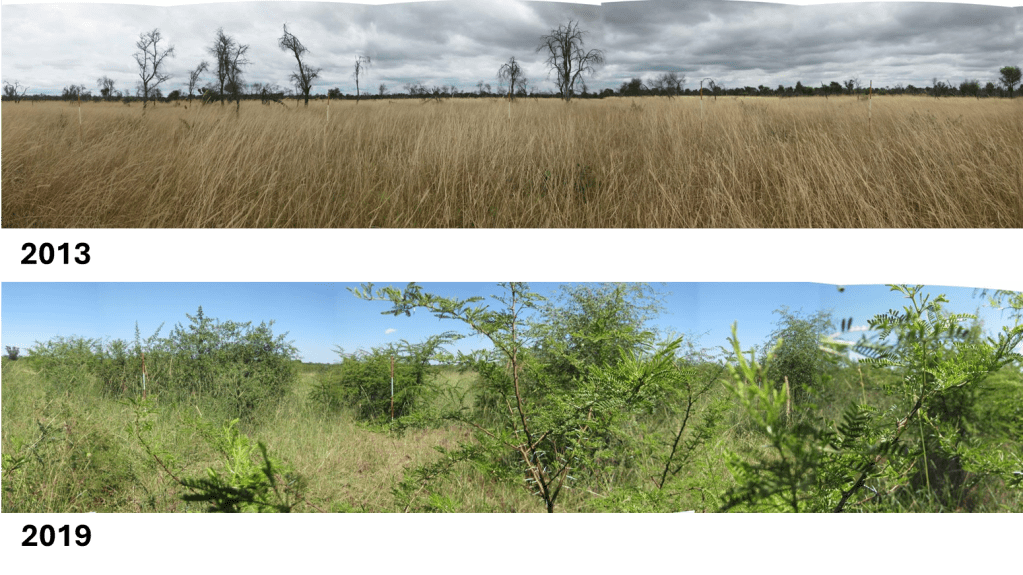
Oppenheimer Masters Scholar Tapiwa Gumbo is working with Shangani Holistic Ranch to identify practical solutions to the worsening bush encroachment that threatens the economic viability of the Ranch, the largest beef producer in Zimbabwe. Treatment interventions that could be upscaled for landscape-level deployment are being tested at replicated sites across the affected landscape.
Oppenheimer Impact Scholar Isaac Mureithi is working with the African Wildlife Foundation in the research initiative “Habitat Intelligence: Decoupling Climate Variability from Anthropogenic Impact in the Amboseli and Tsavo Landscapes.” By applying the Relative Productivity Index and multi-decadal Earth Observation data, the project evaluates vegetation dynamics to identify the primary drivers of landscape-scale productivity shifts and support adaptive rangeland management.
Doctoral Scholar Guy Lomax applied state-of-the-art machine learning tools in East African rangelands to uncover new insights into controls on primary productivity that deepen understanding of how these ecosystems might be affected by climate change. In addition, he led the development of a new rangeland productivity index to distinguish the signal of local land use impacts from that of environmental and climatic variability. The goal is to develop more sensitive tools to identify areas of persistently reduced productivity and support assessment of conservation and management actions.
Lomax et al. (2025) The relative productivity index: mapping human impacts on rangeland vegetation productivity with quantile regression forests. Ecological Indicators 171:113208. DOI:10.1016/j.ecolind.2025.113208
Oppenheimer Doctoral Scholar Glenn Slade is working with the University of Botswana and the Botswana University of Agriculture and Natural Resources to help manage the invasive plant species Neltuma (Mesquite / formerly Prosopis). Glenn is quantifying the extent and serious impact of Neltuma on worsening the livelihoods of marginalised communities across the Kalahari. He is working with local communities and NGOs in western Botswana to control Neltuma and develop projects to restore savanna ecosystem services and biodiversity whilst improving livelihoods. The technical insights from this work are informing a regional project coordinating invasive species monitoring and control across South Africa, Namibia, and Botswana.
OPALS provided modest bursaries to six MSc students at the Meru University of Science and Technology (MUST), Kenya, to help them contribute to and learn from the approaches in TIST. The students have demonstrated the effectiveness of conservation farming methods in promoting soil health and improved yields, thereby supporting higher biodiversity than conventional farming methods.

 Oppenheimer Programme in African Landscape Systems (OPALS)